Most ChatGPT YouTube advice stops at the text. ChatGPT writes you a title, a description or a Shorts script, and you carry it off to an editor and then to YouTube Studio. That’s worth doing, and the prompts I’d use for it are in this guide. Connect ChatGPT to YouTube and it goes further: it can design a short vertical video, save it as a Short draft with a title, and read your channel numbers back to you. The setup takes about 2 minutes, and you don’t need a Google Cloud project.
I’m Anton, founder of PostHero. I built the connector that lets AI assistants post to YouTube, and making short videos inside a chat is the part of it I’ve spent the most time on. This guide starts with the setup, then covers copy-paste prompts, what ChatGPT can and can’t do on YouTube, YouTube’s rules for apps that upload for you, and how the options compare. If you only came for prompts, the ChatGPT prompts for YouTube titles, descriptions and Shorts scripts are further down, and they work without connecting anything.
How to connect ChatGPT to YouTube
- Create a PostHero account and connect your YouTube channel.
- On chatgpt.com, open Plugins, click the + button and choose Add custom MCP server.
- Name it PostHero, paste https://mcp.posthero.ai/mcp, choose OAuth, confirm the warning and create it.
- Sign in to PostHero, turn it on in a chat and ask: “list my connected accounts”.
What you need before you start
- A YouTube channel. You link it to PostHero on Google’s own sign-in screen, so neither ChatGPT nor PostHero sees your Google password.
- No Google Cloud project. Wiring this up yourself means a developer project, an OAuth consent screen and an upload quota to look after. PostHero carries all of that.
- A ChatGPT plan that lets you add custom MCP servers. OpenAI decides which plans get this and has changed it more than once this year. If Plugins doesn’t show “Add custom MCP server” for you, your plan or workspace doesn’t allow it yet. On Business, Enterprise and Edu workspaces, an admin may need to add it or switch it on.
- The same PostHero account in both places. Sign in to the connector with the account where you linked YouTube. Otherwise ChatGPT connects happily and then finds no YouTube channel.
- chatgpt.com for the setup. Add the connector in ChatGPT on the web.
- A video and a title for every upload. YouTube has no text-only posts, and it won’t publish a video without a title. ChatGPT can make the video for you, or you can upload your own file to your PostHero media library and tell ChatGPT to use it.
- A phone-verified channel if you want custom thumbnails or videos longer than 15 minutes. That’s YouTube’s rule, and it takes a minute at youtube.com/verify.
Several channels? Connect each one and tell ChatGPT which to use. The same connector also covers LinkedIn, X, Threads, Instagram, Facebook, TikTok and Bluesky. I’ve written the ChatGPT versions for three of them so far: ChatGPT for Instagram, ChatGPT for TikTok and ChatGPT for X. The guide to connecting AI to all 8 social platforms shows what works on each one, and why I built PostHero for any AI assistant instead of just one is in PostHero goes agentic.
Can ChatGPT post to YouTube?
Not on its own. ChatGPT can write titles, descriptions and scripts, but it has no access to your channel. With a connector like PostHero, ChatGPT can design a short vertical video, save it as a YouTube Short or a regular video draft with a title, schedule it, or publish it after you confirm.
So there are two ways to use it, and this guide covers both:
- ChatGPT on its own: ideas, titles, descriptions and scripts that you paste into YouTube Studio yourself. The prompts are here.
- ChatGPT connected to your channel: it makes the video, saves the draft and checks what worked. That’s the setup above, and it takes about 2 minutes.
Want ChatGPT to summarize a YouTube video instead?
Plenty of people who search “ChatGPT YouTube” want this, so here’s the quick version. The dependable route is the transcript: open the video’s description on YouTube, click Show transcript, paste the text into ChatGPT and ask for a summary with timestamps. If you do this every day, a browser extension saves the copying. AI Summary for YouTube (you may know it by its old name, “ChatGPT for YouTube”) puts a summary next to the player and has about 100,000 users on the Chrome Web Store.
That’s all I’ll say about watching. The rest of this guide is for people who make videos.
ChatGPT prompts for YouTube: ideas, titles, descriptions and Shorts scripts
These work in any ChatGPT chat, connected or not. The usual mistake is asking cold. “Write a YouTube title about productivity” gets you the average productivity title, and the average title is what everyone else is already uploading.
Give it your channel first. One message at the top of the chat does more than any clever wording later:
I run a YouTube channel about [niche] for [who watches]. I make [Shorts / long videos / both]. Here’s a video of mine that did well: [title, and what happens in it]. Here’s one that didn’t: [title, and what happens in it]. Keep all of this in mind for everything I ask in this chat.
Then ask for one thing at a time. Swap the parts in brackets for your own.
Video ideas
The best ideas I get out of an AI come from my own week: a call that went badly, a question two users asked, something I got wrong. ChatGPT only knows your week if you tell it, so paste your notes in, however rough.
Here’s what happened in my work this week: [paste notes, wins, annoying moments]. Give me 5 YouTube video ideas. Each one must come from a real moment in that list. For each, say whether it’s a Short or a long video, and give me a title someone would actually type into YouTube search. One line each.
Here are the titles of my last 10 videos: [paste]. Which topics have I covered twice, and what are 5 questions a viewer of these videos would ask next? One line each.
Titles
On YouTube the title does real work, even on a Short. A reel or a TikTok lives on its first second and its caption. A Short shows a title as well, and YouTube search reads it. So ask for options, and ask for the words people type.
Give me 10 titles for a YouTube video about [topic]. Under 60 characters each. Put the words someone would search for at the start. No clickbait, no ALL CAPS, no “you won’t believe”. Mark the 3 you’d test first and say why.
Here’s my title: [paste]. Here’s what the video actually delivers: [one sentence]. Does the title promise more than the video gives? Rewrite it 3 ways that stay true to the video.
Descriptions, chapters and tags
This is the dull part of every upload, which makes it the best part to hand over. Give ChatGPT the transcript and it has everything it needs.
Here’s the transcript of my video, with timestamps: [paste]. Write a YouTube description. Start with one line saying what the video is about, then 2 short paragraphs, then chapters starting at 0:00. Add 10 tags. Don’t add anything that isn’t in the transcript.
Write a 2-line description for a YouTube Short about [topic]. Line 1 says what the Short shows. Line 2 points to [my longer video on the same topic]. 3 hashtags at most.
ChatGPT YouTube Shorts scripts
Paragraphs of script don’t help when the whole video is 25 seconds long. You need to know what’s on screen in each beat, so ask for scenes.
Write a 25-second YouTube Short about [topic]. Split it into scenes. For each scene give me the on-screen text in under 8 words and what’s shown behind it. The first scene has to make sense with the sound off. One idea per scene. End on a line worth saving, and give me 3 title options under 60 characters.
If you film yourself, ask for something you can say out loud:
I’m filming this Short myself. Write a 30-second script about [topic] the way I’d say it to a friend: the hook line, then 3 beats with what I say and the text on screen, plus a B-roll idea for each beat. No intro, no “hey guys”, no “don’t forget to subscribe”.
Long videos, and Shorts cut from them
Outline an [8]-minute YouTube video about [topic] for [who watches]. Give me the first 30 seconds word for word, then the sections with one line on what each one shows. Tell me where a viewer is most likely to click away, and what I should put there to keep them.
Here’s the transcript of my long video, with timestamps: [paste]. Find 3 moments that would stand on their own as Shorts. For each one, give me the start and end timestamps, a hook for the first 2 seconds and a title.
Where plain ChatGPT stops
Use those prompts for a few weeks and you hit the same wall from two sides. ChatGPT can’t see your channel, so “what’s working for me?” gets a guess built from whatever you pasted. And it can’t touch a video. The script still has to become a file in an editor, and then the file, the title, the description, the tags and the publish time all go into YouTube Studio by hand.
Connecting it removes both. If you skipped the setup, it’s at the top of this guide.
What ChatGPT can do on YouTube through PostHero
- Make a short vertical video in the chat. ChatGPT designs every scene, PostHero renders the video, and it lands in your media library ready to post.
- Add sound and your own footage. Background music, a voiceover and sound effects go in before the render, and clips from your media library can be used as scenes.
- Post Shorts: vertical videos up to 3 minutes, each with a title.
- Post regular videos of any length your channel allows, from a file in your media library.
- Write the text fields: titles up to 100 characters, descriptions up to 5,000, and tags.
- Set privacy: public, unlisted or private.
- Set a custom thumbnail on regular videos (1280×720).
- Schedule for any date and time you give it.
- Read your channel analytics: reach, likes, comments, shares and subscribers for a period, plus your top videos ranked by the metric you pick, including watch minutes.
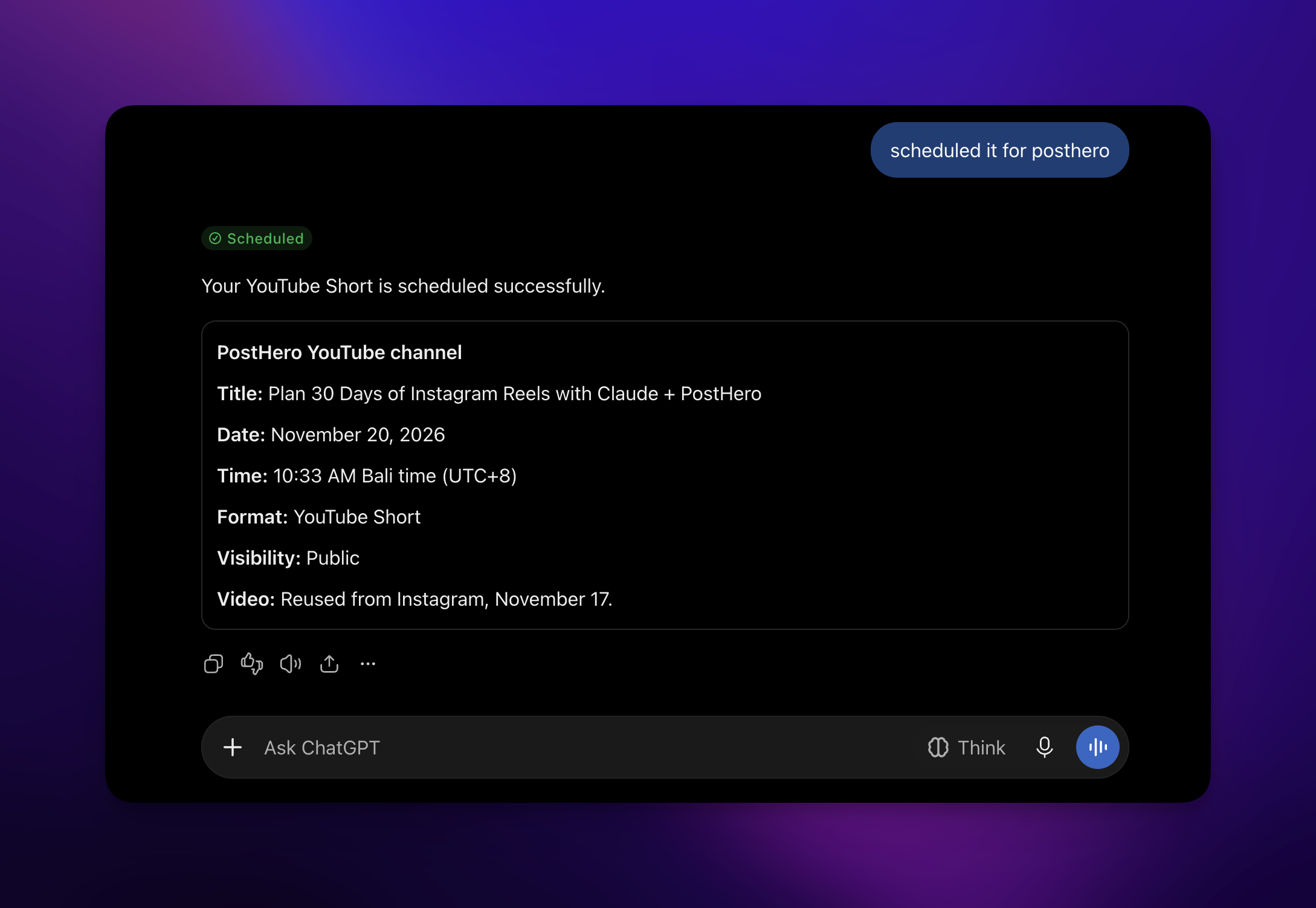
Every upload is saved in PostHero as a draft first. ChatGPT schedules when you give it a time. It publishes only when you ask, and then it checks with you once more before anything goes live. I built it that way on purpose. One video published half-finished is enough to stop trusting an assistant with your channel.
What it can’t do yet
- Playlists. It can’t add a video to one.
- The “made for kids” and altered-content labels. You set those in YouTube Studio (more on that in the rules below).
- Comments. It can’t read them or reply.
- Edits to a video that’s already live.
- Thumbnails on Shorts. YouTube’s API doesn’t accept one.
- YouTube research. The viral library and competitor tracking don’t cover YouTube. They work on Instagram for now, which is what the ChatGPT Instagram guide is mostly about.
- Ads. It’s organic uploads only.
From a ChatGPT-made video to a YouTube Short
Most options in the comparison further down assume your video already exists. Here it comes out of the same chat.
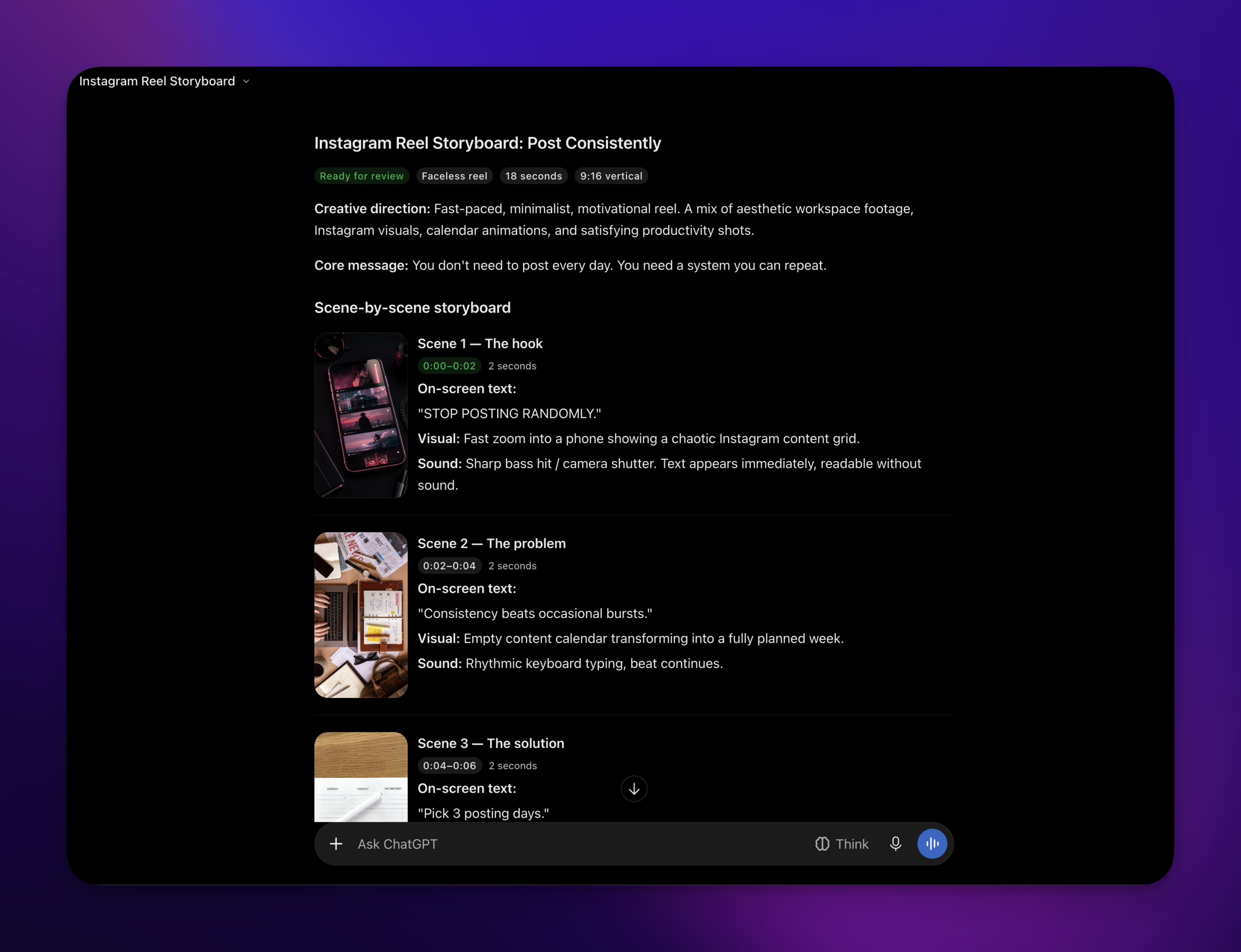
- ChatGPT designs the video. You describe the idea, and ChatGPT writes a storyboard scene by scene and shows it to you. Change whatever you like. Before anything renders you can pick background music, a voiceover and sound effects, and drop your own clips in as scenes.
- PostHero renders it. About a minute later there’s a vertical video in your media library. PostHero renders what ChatGPT designed and you approved, nothing more. With most tools you design inside their editor. Here the conversation is the editor.
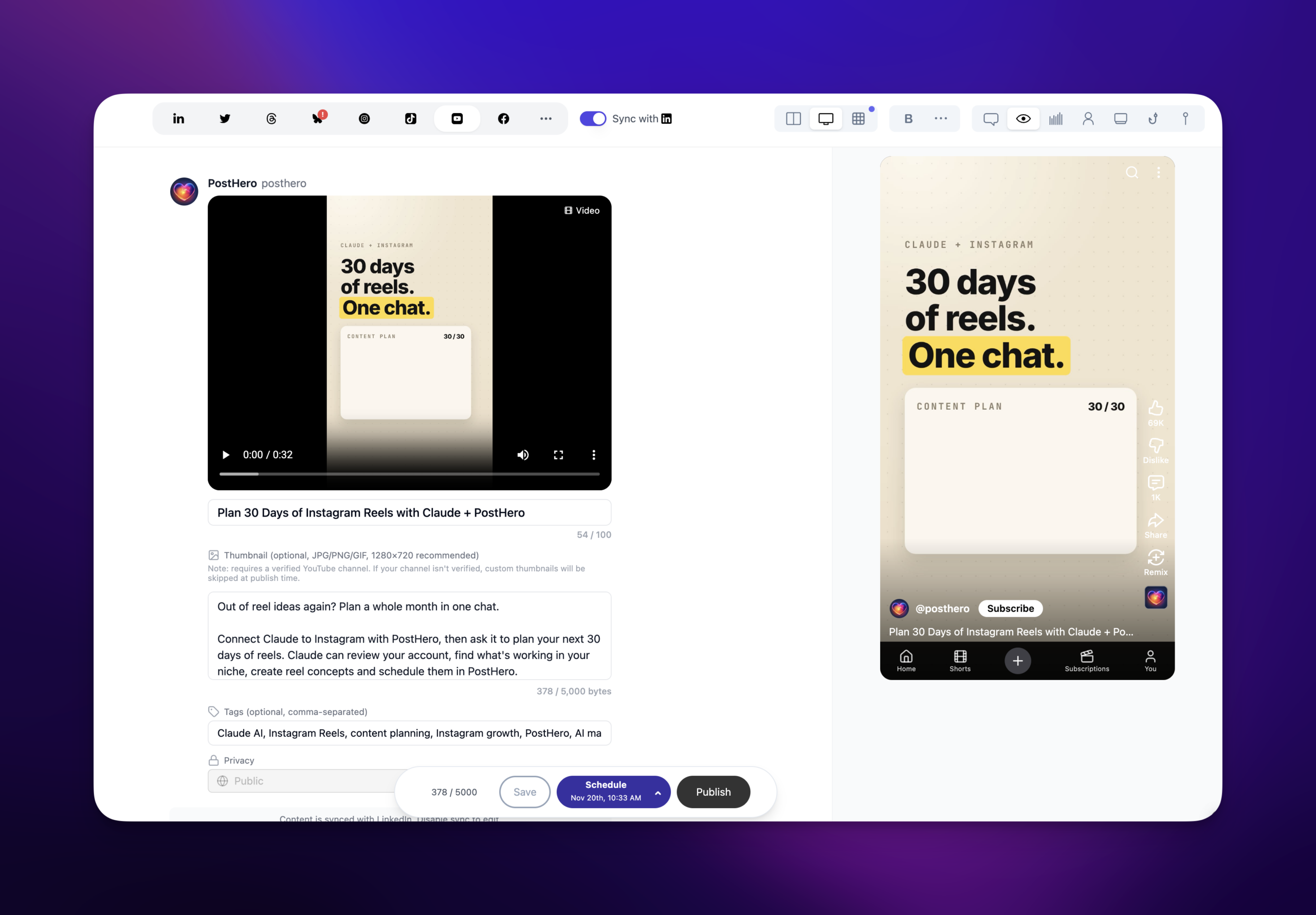
- ChatGPT saves it as a Short. The file becomes a YouTube Short draft with a title, a description written for YouTube, tags and the privacy you asked for.
Once it’s saved, the draft sits in PostHero, where you can look it over before it goes anywhere.
Regular videos work the other way round, because ChatGPT isn’t going to film your 20-minute tutorial. Upload the edited file to your media library and hand over the chores: the title, a description with chapters from your transcript, the tags, the thumbnail you made, the publish time.
Talking-head Shorts sit in between. ChatGPT can’t film you, but it can write the filming script (the hook, the beats, the on-screen text, B-roll ideas) and attach it to the draft, so it’s waiting in PostHero when you pick up the phone.
What I’ve learned making videos in a chat
I don’t have a view count from a ChatGPT-made YouTube video to show you yet, and I’d rather say that than borrow one. PostHero users post Shorts and long videos to YouTube regularly. Chat-made video on YouTube is newer, and I have no stats for it.
What I do have comes from Instagram, made in Claude through this same connector. My first AI-made videos were forgettable. I was typing things like “make a video about social media scheduling” and getting the average video on that topic. The jump came from borrowing structure: I had a competitor’s viral reel broken down scene by scene and built my own on that skeleton. It got 719 views against my usual 64, about 11 times more. Different platform, different assistant, so take it as evidence for the method and nothing else. The method carries over, though. Describe a Short that did well in your niche, or paste its transcript, and ask ChatGPT for the same breakdown before it designs yours. The step-by-step version is in the Instagram reels guide.
A few things I’d tell anyone starting on YouTube:
- Basic prompts give basic videos. “Make a YouTube Short about my niche” is where most bad results come from. Give ChatGPT a specific idea, a structure that already works, or something that really happened to you.
- Title for search, first second for the scroll. The opening has to stop the thumb. The title has to match what someone would type. People skip the title because reels and TikToks never asked for one.
- Don’t port posts from other platforms. A LinkedIn post chopped into on-screen text is still a LinkedIn post, and it looks like one.
- Expect a few attempts. Good videos take several rounds. That’s a skill you’re building, and it says nothing bad about the tool.
I also think this is where editing is heading. With the right instructions and prompts, a chat already covers a lot of what expensive editing software does, and I expect most top creators to edit with ChatGPT, Claude or another model before long. For complicated, high-stakes work (multi-camera cuts, color grading, a sponsored piece), a dedicated editor is still the better tool today.
Here’s the standing instruction I’d start every YouTube chat with:
For everything you save to YouTube in this chat: titles under 60 characters, built from words people search for, no clickbait. Descriptions open with one line on what the video is about. On-screen text stays short enough to read in a second. Casual tone, no pitch. Show me the title, description and tags before you save anything.
One video, three places: a Short, a TikTok and a reel
A vertical video under 3 minutes is the same file on YouTube, TikTok and Instagram. What changes is the text around it, and that’s the part worth a minute of thought.
| Where it goes | What it needs | What does the work |
|---|---|---|
| YouTube Short | A title (up to 100 characters), plus a description and tags | The title, because YouTube search reads it |
| TikTok | A caption (up to 2,200 characters) | The first second and a casual caption |
| Instagram reel | A caption, and a Business or Creator account | The first second and the caption |
The mistake I see is one caption pasted three times, with its first line recycled as the Short’s title. Ask for three separate texts instead. It costs you one sentence in the prompt:
Use the video we just made for a YouTube Short, a TikTok and an Instagram reel. Write each one its own text for that platform: a searchable title and a 2-line description for the Short, a casual caption for TikTok, a separate caption for the reel. Save all three as drafts and show me the texts side by side first.
Two practical notes. Reuse the clean file from your media library, not a download with another app’s watermark on it. And each platform keeps its own extras: on TikTok, ChatGPT can send the video to your TikTok inbox so you add a sound in the app first, which is covered in the ChatGPT TikTok guide.
YouTube rules worth knowing
YouTube treats apps that upload for you differently from the upload button in YouTube Studio. A few of those differences change how you should run this from ChatGPT.
The private-upload lock is gone. For years, a video uploaded through a new, unverified app was locked to private, whatever privacy you asked for. Google reversed that on 2 November 2026, according to the YouTube API revision history. Many guides still warn about it, and that warning is out of date. What replaced it matters more for a chat workflow: when an app sends no privacy setting at all, the upload defaults to public (Google adds that a channel’s own settings can still make some uploads private). So name the privacy you want in every prompt, and use unlisted for anything you’d like to look at on YouTube before the world does.
There’s no “Short” switch in the API. YouTube decides from the file: vertical or square, and up to 3 minutes. Tell ChatGPT it’s a Short and PostHero sends it that way, but a horizontal 4-minute file will still come out as a regular video.
Two labels live in YouTube Studio. YouTube asks you to say whether a video is made for kids, and to disclose realistic altered or synthetic content, like a realistic AI voice of a real person. PostHero sets neither. If a video needs one, have ChatGPT upload it as private or unlisted, set the label in Studio, then make it public. A text-and-motion video like the ones ChatGPT designs usually isn’t what the altered-content label is for.
Custom thumbnails need a verified channel. Without phone verification YouTube ignores the thumbnail. Shorts can’t take one through the API at all, so make the first frame do that job.
Uploads count against a daily allowance. Google gives every app one. You won’t notice it posting a few videos a day. Don’t plan to push a whole back catalogue through ChatGPT in one afternoon.
One practical note: a new upload can take a while to process, longer for long videos. If it looks blurry or isn’t on your channel yet, give it a few minutes.
Ways to use ChatGPT with YouTube, compared
I couldn’t find a YouTube plugin for ChatGPT from Google, so every option is a third party. Most of them do one job: read your numbers, or publish a file you already made.
| Option | Makes the video | Uploads to YouTube | Reads your stats |
|---|---|---|---|
| PostHero | ✅ ChatGPT designs, PostHero renders | ✅ Shorts and videos, draft first | ✅ Yes |
| vidIQ | Clips from a long video | ❌ Edits videos already on your channel | ✅ Yes, plus keywords and competitors |
| Composio | ❌ Bring your own | ✅ Yes, plus playlists and comments | ✅ Yes |
| Upload-Post | ❌ Bring your own, it can trim | ✅ Yes, from a public link, with playlists | ✅ Yes |
| Windsor.ai, Supermetrics | ❌ No | ❌ No, reporting only | ✅ Yes, in depth |
| invideo | Shorts cut from your long video | ❌ You export and upload | ❌ Not covered |
| AI Summary for YouTube extension | ❌ No | ❌ No | ❌ No, it summarizes videos you watch |
| ChatGPT on its own | Scripts and titles only | ❌ No | Only what you paste |
Based on each vendor’s own pages, checked 19 November 2026.
My take:
- vidIQ if you want research: keywords, competitor channels, your own analytics, and better titles on videos that are already live. Its page is blunt that it edits and doesn’t upload. TubeLab does a similar job on public YouTube data.
- Windsor.ai or Supermetrics if all you want is ChatGPT answering questions about your channel numbers. Both go deeper on reporting than PostHero does.
- Composio or Upload-Post if your videos are already edited and you need something PostHero doesn’t set yet, like playlists or comments.
- invideo if your raw material is a long video and you want Shorts cut out of it. You upload the results yourself.
- PostHero if you don’t have the video yet and want ChatGPT to make it, then post it to YouTube and your other platforms from the same chat. That’s the gap I built it for.
Some of these install from ChatGPT’s own plugin listing in a click. PostHero you add by URL, which takes about a minute longer.
ChatGPT YouTube prompts for posting and analytics
These only work with PostHero connected, because they ask ChatGPT to make real videos and save real drafts.
Idea to Short draft in one prompt
Make me a YouTube Short about [idea].
1. Design a 20 to 30 second vertical video: hook in the first 2 seconds, short on-screen text, casual tone, no pitch. Show me the storyboard scene by scene, suggest music and tell me where a sound effect would help. Don’t render until I say yes.
2. After I approve, render it with PostHero.
3. Save it as a YouTube Short draft on [channel]: 3 title options under 60 characters, a 2-line description and 5 tags. Public.
Drafts only, never publish.
Make the video
Use [clip name] from my PostHero media library as the opening scene and build the rest of the Short around it. Show me the storyboard before you render anything.
This Short did well in my niche: [describe it or paste the transcript]. Break down why it works, scene by scene. Then design my own Short about [my topic] on the same structure, in my words.
Post it
Save the video we just made as a YouTube Short draft for [channel]. Unlisted for now. Show me the title, description and tags before you save.
Take from my PostHero media library and set it up as a regular YouTube video. Transcript with timestamps: [paste]. I need a title under 70 characters, a description with chapters from 0:00, 10 tags, and [thumbnail file name] as the thumbnail. Unlisted, scheduled for [day, time, timezone]. Show me all of it before you save.
I’ll film this Short myself. Write the filming script (hook, 3 beats, on-screen text, B-roll ideas) and attach it to a YouTube Short draft titled [title], so it’s in PostHero when I record.
Schedule the Short draft for [day] at [time] my time. Don’t publish anything else.
Analytics
Show my YouTube reach, likes, comments, shares and subscriber change for the last 30 days. Then rank my top 5 videos by watch minutes and tell me what the best ones have in common.
Based on my top YouTube videos this month, suggest my next 3 Shorts. For each one, tell me which past video it builds on, the hook and a title.
Using Claude instead?
It’s the same connector with the same tools, and the drafts land in the same place. The one difference I’ve noticed is the storyboard, which ChatGPT lays out a bit differently from Claude. I can’t tell you which is better. It comes down to which assistant you like working in. If that’s Claude, the setup and screenshots are in my Claude YouTube guide.
ChatGPT isn’t posting to YouTube: quick fixes
- The connector isn’t on in this chat. Pick PostHero from the + menu in a new chat, or mention PostHero by name in your message.
- There’s no “Add custom MCP server” option. Your plan or workspace doesn’t allow custom servers. On a work workspace, ask your admin.
- ChatGPT finds no YouTube channel. You’re probably signed in to a different PostHero account than the one with YouTube linked. Disconnect, then sign in with the right one.
- The draft saved but won’t publish. YouTube needs a video and a title. A description on its own won’t go out. ChatGPT sees the same warning and can fix the draft.
- Your own video won’t attach. ChatGPT can’t pass files from the chat to PostHero. Upload the video to your PostHero media library first, then ask ChatGPT to use it.
- Your Short came out as a regular video. YouTube decides that from the file. It has to be vertical or square and no longer than 3 minutes.
- The thumbnail didn’t show up. Your channel needs phone verification, and Shorts don’t take custom thumbnails through the API.
- It posted but isn’t on your channel. Give YouTube a few minutes to process it, then check the privacy setting. Unlisted and private videos don’t appear on your channel page.
FAQ
Can ChatGPT post to YouTube?
Not on its own. With a connector like PostHero, ChatGPT saves YouTube uploads as drafts, schedules them, or publishes them once you ask and confirm.
Can ChatGPT make YouTube Shorts?
Plain ChatGPT writes the script. With PostHero connected, it designs a short vertical video scene by scene and PostHero renders it, with optional music, voiceover and sound effects. Then ChatGPT saves it as a Short with a title. For videos you film yourself, it writes the filming script and attaches it to the draft.
Can ChatGPT upload a long YouTube video?
Yes, through a connector, from a file you’ve already edited. Upload it to your PostHero media library and ChatGPT sets the title, description, tags, thumbnail, privacy and publish time.
Can ChatGPT summarize a YouTube video?
Yes, from its transcript. Copy the transcript from the video’s description on YouTube and paste it into ChatGPT, or use a browser extension that does it for you.
Can ChatGPT see my YouTube analytics?
Only through a connector. Without one, it knows the numbers you paste in and nothing more.
Will ChatGPT post to YouTube without asking me?
Not with PostHero. Everything starts as a draft, and publishing needs your go-ahead plus one confirmation. You can also upload as unlisted or private first.
Is it safe to connect ChatGPT to YouTube?
Yes, with a connector that uses Google’s official sign-in. You approve access on Google’s own screen, so your password stays with Google. ChatGPT shows a warning when you add a custom MCP server, because OpenAI doesn’t review them, so only add servers from companies you trust.
Is it free to connect ChatGPT to YouTube?
PostHero has a 7-day free trial, so you can test the whole workflow first. On ChatGPT’s side you need a plan that allows custom MCP servers.
Does it work with my other platforms?
Yes. The same connector covers LinkedIn, X, Threads, Instagram, Facebook, TikTok and Bluesky, so one video can go to YouTube, TikTok and Instagram from a single chat.
PostHero for ChatGPT
Make your next YouTube Short in ChatGPT
Connect in 2 minutes. ChatGPT designs the video, PostHero renders it, and nothing goes live until you approve it.
7-day free trial. Everything starts as a draft.
Leave a Reply